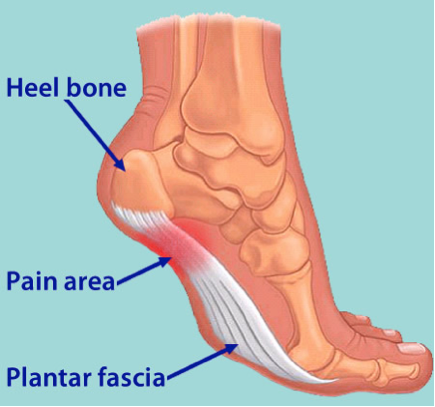
If you are in that lucky 10% of the population that has heel pain and you think it may be plantar fasciitis you may be wondering what to expect when you see your podiatrist. During you first visit your doctor will review you medical history and ask you specific questions about your heel pain that can help to confirm the diagnosis. One of these questions will be WHEN do you get the pain. If it is plantar fasciitis the pain should be the worst with the first couple steps in the morning or after getting up from sitting for a period of time. Your doctor will also likely take an x-ray of your foot to see if there are any fractures of heels spurs present. The presence or absence of a heel spur does not confirm or eliminate the diagnosis of plantar fasciitis but if there is a heel spur present it suggests that the plantar fascia is pulling on the heel bone at its insertion causing new bone to form… hence a heel spur.
Once your doctor has determined that you do indeed have plantar fasciitis he or she will review your treatment options. In my practice there are three tiers of treatment options:
Treatment Tier One:
- Change shoe gear to supportive shoes… no flats or heels!
- Avoid barefoot walking
- Stretch, stretch, stretch… I give patients a hand out of stretching exercises that help to improve plantar fascial symptoms. I emphasize stretching prior to getting out of bed in the morning in order to prevent those first painful steps.
- Anti-inflammatories – Since plantar fasciitis is an inflammatory condition this help to counteract the inflammation and alleviate pain.
- Icing – Again this aims at decreasing inflammation. A trick I tell patients is to freeze a water bottle and roll it under the arch for 20 minutes, 3 times daily.
Treatment Tier Two:
- Orthotics – these are arch supports that go inside the shoe to help prevent the arch from collapsing and the plantar fascia from tugging on the heel bone. These can either be over the counter or custom fabricated for your foot.
- Steroid injection – the purpose of the injection is to decrease the inflammation surrounding the plantar fascia and thus decrease pain.
- Physical Therapy – there are many physical therapy modalities that can help relieve plantar fasciitis including ultrasound therapy, graston therapy, and stretching and strengthening exercises. I normally have my patients go to therapy 2-3 times per week for 4-6 weeks.
Treatment Tier Three:
- Casting – In patients who are simply not improving with conservative treatments and want to avoid surgery I recommend casting the patient for 4 weeks to allow the plantar fascia to heal.
- Extracorporeal shock wave therapy – this options is not covered by insurance but can be useful in recalcitrant cases for plantar fasciitis.
- Surgery – A plantar fascial release is an effective treatment options when conservative options have been exhausted.
Plantar fasciitis can be a debilitating condition but in most cases it is only temporary and can be cured with conservative treatment options. Hopefully this blog has provided you with some basic concepts on plantar fasciitis and what to expect when you see your podiatrist.